


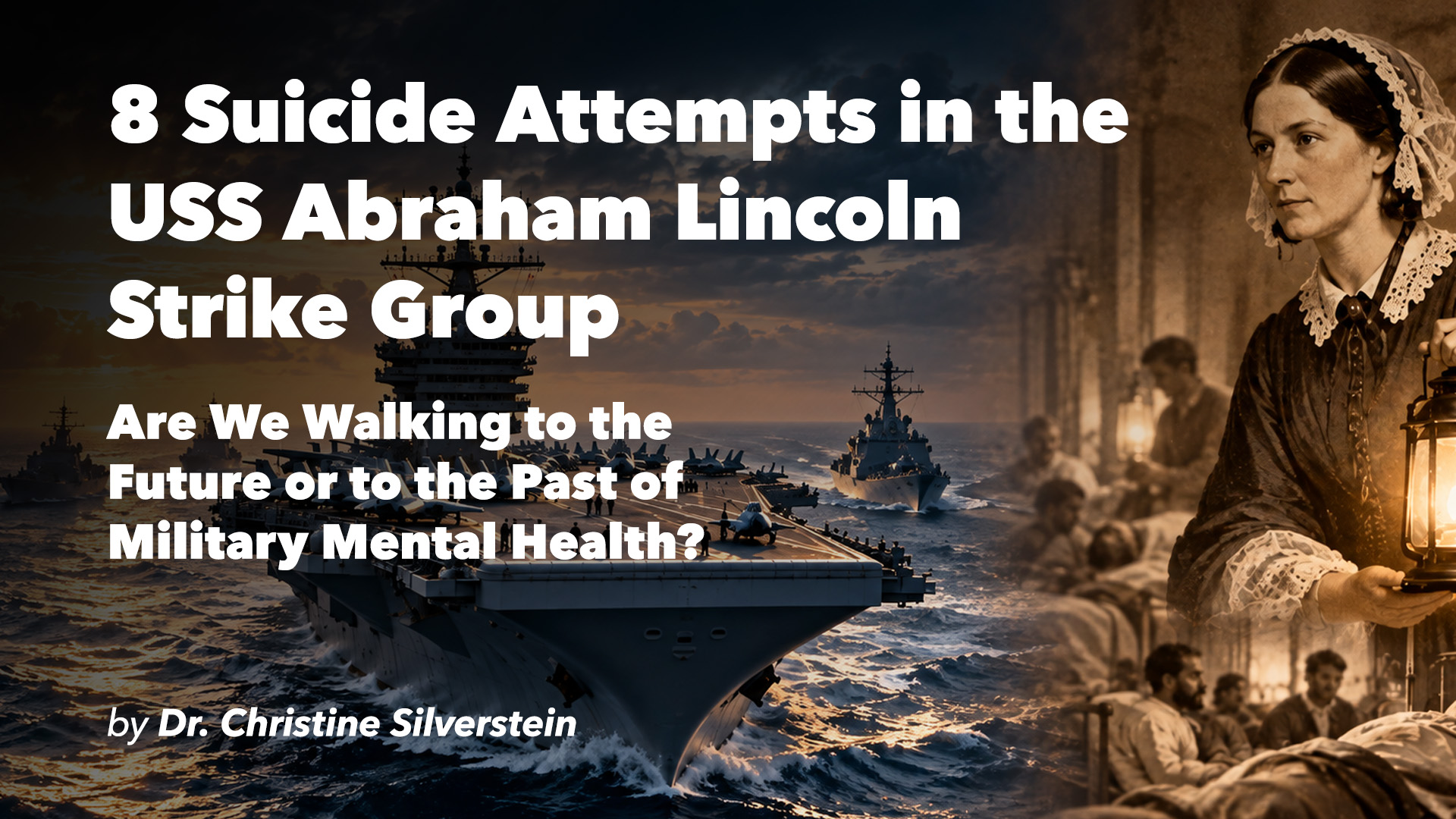
Eight US Navy personnel assigned to the USS Abraham Lincoln carrier strike group attempted suicide during its extraordinarily long deployment, Acting Secretary of the Navy Hung Cao disclosed in September 2026. No service members died by suicide. The disclosure followed months of concern from sailors’ families and lawmakers about the psychological toll of extended combat operations and conditions at sea. Stars and Strips
For me, the disturbing news raises a larger question that reaches far beyond one ship or one deployment. What have we learned about caring for the minds, bodies, and spirits of those we send to war? Looking back more than 170 years to Florence Nightingale’s care of soldiers during the Crimean War may help us decide whether we are walking toward the future of military mental health—or back toward its past.
In my life, US wartime naval battles made an indelible imprint on my memory as a young child when my dad, a World War II Navy veteran, invited me to watch TV reruns of Victory at Sea that showed actual combat footage of cannons and artillery firing at enemy ships to sink them. Other than this time shared, he never spoke openly of his wartime traumas.
The legacy of my father’s service and his reverence for war history was passed down to me as an RN and doctoral student at Columbia University. After graduation, I visited the British Library to access the extensive archive of Florence Nightingale to learn about her great work during the Crimean War (1853-1856) and to apply it to mine as a performance coach.
Recently, I looked at my records to see how Nightingale successfully cared for combatants holistically in body, mind, and spirit with reverence in contrast to the administrative mishandling and irreverence towards the crew leading up to 8 suicide attempts on the USS Abraham Lincoln carrier strike group during the Iranian War, which is our discussion today.
This is so because I am alarmed thinking about how US Navy officials did not properly prepare our crews at sea for the long haul to promote mental health during a time when suicide is the second leading cause of death in the US for those aged 15-24, which should’ve informed them on how to proceed before a sailor had already jumped ship.
My Lived Experience Guided Me
As a historian and behavioral health RN, I understand what the ramifications of this mismanagement may mean in the future of mental health in the military because I know them firsthand after I presented a paper at Fordham University at the International Psychohistorical Association (IPA) Convention in 2008 titled: “Suicide in Iraq.”
At that time, I discussed how subsequent epidemiological studies had analyzed the 2004-2008 trends of the all-time rising suicide rates in Iraq of active-duty members of the Army and concluded that prolonged combat operations, repeated deployment, and mental health pressures like depression and PTSD strongly contributed to the surge.
The haunting image I have of my presentation is when an RN Navy vet from the Vietnam War, who was sitting in the audience, broke down into tears and was at a loss for words as she relived serving on a Naval hospital ship and of caring for many young, fatally injured soldiers with mangled bodies, broken spirits, and PTSD as they took their last trip home.
To me, she represented how war trauma lingers on while we see history repeating itself on the USS Abraham Lincoln carrier strike group because suicide remains alive as seen in the Department of Veterans Affairs annual report released in 2026 that documented 6,488 veterans died by suicide in 2024 averaging 17.7 per day with the highest risk to young people ages 18 to 34. VA News
Comments Made about 8 Attempted Suicides and Conditions Onboard
Initially, after the suicide attempts, officials in the US government and Navy made comments about the 8 suicides but later changed their minds or added to it. Here are some responses to consider from the President all the way down to the crew members.
President Donald J. Trump
In the New York Times, Trump previously dismissed concerns about the length of the deployment and remarked in August that it was “not nearly long enough.” He believed that family members were not worried about living conditions and mental health. Stars and Strips
Defense Secretary Peter Hegseth
Initially, in an interview on Newsmax in August 2026, Hegseth dismissed reports of low morale, stress, and suicide attempts aboard the USS Abraham Lincoln carrier strike group. He downplayed the concerns and defended the administration’s support for the fleet.
Secretary of the Navy
A disclosure was made in a letter sent by Hung Cao, the Acting Secretary of the Navy, on September 22, 2026, to Senator Kirsten Gillibrand of New York in response to the Democrat’s questions regarding the well-being of sailors aboard the ship and to family members of sailors who had raised alarms.
The US Navy previously said, according to Zachary Cohen of CNN in his report on September 24, 2026, that it did not observe an increase in suicidal ideations or attempts aboard ships. However, Sareen Habeshian of the BBC reported on the same date that the Acting Navy Secretary Hung Cao admitted that crew members attempted suicide but no deaths occurred.
The fact is that one sailor jumped ship but was recovered by a helicopter, and the other was prevented from jumping by his shipmates.
In his letter, Cao defended his position of meeting the spiritual and emotional needs of those on board by claiming that there were five chaplains and multiple professionals, including a psychologist, social worker, mental health technicians, and a therapy dog.
Yet, a Navy official previously told CNN, according to Cohen, that the Navy doesn’t think there is a correlation between deployment length and thoughts of self-harm or that overboard incidents, like jumping ship, aren’t unique to this group.
Cao denied widespread concerns about broken plumbing and shortages of fresh food and acknowledged only “piping failures.” He admitted to temporary problems with reverse osmosis desalination units that supplied fresh water and agreed that meal options were only reduced for a “short time.”
Senator Kirsten Gillibrand
Senator Gillibrand stated these words during a BBC interview: “What Trump and Secretary Hegseth dismissed as ‘fake news’ turned out to be serious and deteriorating conditions for our service members,” as reported by Habeshian.
Alison Bath from Stars and Strips reported that Gillibrand acknowledged to make her point: “Our troops and their families make immense sacrifices every single day, yet the President dismissed them with open disrespect.”
Crew Members
A crew member serving on the USS Abraham Lincoln carrier strike group previously described to CNN, according to Cohen on September 24, 2026, that morale on the carrier was very low. He had repeatedly heard about suicidal ideation by fellow crew members and that there were regular strains on essential amenities, such as toilets and water fountains around the ship that were frequently closed, along with hot water being unavailable.
Another reporter from CNN, Pamela Brown, talked to service members aboard the USS Abraham Lincoln about the mental toll of deployment while speaking to carrier members who said: “Everyday we wake up and listen to our captain speak; we are desperately hoping and anxious for updates on our return.”
Other sailors aboard the USS Abraham Lincoln who spoke with CNN, as reported by Brown, described conditions unlike their previous deployments because of combat that had kept the carrier from making stops at friendly ports where they could take on new supplies and allow sailors R&R there.
Parents of Crew Members
CBS News reported that parents and families of service members deployed aboard the USS Abraham Lincoln carrier strike group expressed deep concern over grueling deployment extended to lengths exceeding 250-260 days without port calls and severe mental health strains on the crew, making parents advocates for a re-evaluation of Navy training for younger generations.
Parents reported broken facilities like washing machines. Feeling frustrated with leadership, families publicly condemned dismissive remarks from officials and political figures who downplayed their reports or called conditions “misrepresented.”
Veterans and Military Advocacy Groups
Vets and advocacy groups emphasized that the attempted suicides highlight severe, unaddressed mental health strains and deteriorating conditions during extended deployment. PBS
Commentators pointed out leadership failures at high levels for ignoring the harsh realities of prolonged deployments that take a high psychological toll. They gave support, reminding sailors that they are not alone. Navy Times
Indeed, this is true of the combatants of the Crimean War. They were not alone because they had a cadre of “nurse” volunteers by their side headed by Florence Nightingale who was a great administrator and caregiver as you shall see by reading on.
Circumstances in Scutari Upon Arrival during the Crimean War
Nightingale arrived at the Barrack Hospital in Scutari on November 4,1854, with the initial group consisting of 38 female volunteers, including nuns and secular nurses (Gillian Gill, Nightingales, 2004). She faced deplorable conditions, such as:
- Severe overcrowding with thousands of wounded men lined up for miles in dark hallways while lying directly on filthy floors.
- Since the hospital was built over a massive cesspool, sewage backed up into wards and from open privies onto floors. Portable water was scarce.
- Rampant diseases such as typhus, cholera, and dysentery tore through the wards, killing more solders than battlefield wounds.
- The soldiers severely lacked medical supplies, clean bedding, personal items, and clothing after arriving from battle in blood-soaked tattered blankets.
- The poorly equipped kitchen served tiny amounts of contaminated, undercooked foods that were cold and did not satisfy the nutritional needs of patients.
What did Nightingale Do as an Administrator and Caregiver?
Nightingale expressed her disfavor for the conditions she saw upon arrival in Crimea and wrote home in a letter to the Queen and to the everyday citizens these words: “In England you go upon a fallacy, you think we want to save Men’s lives—we don’t—we don’t care whether the men live or not…” Nightingale Papers,1855: British Library
- By setting high standards for sanitary protocol at the Barrack Hospital, Nightingale improved healthy standards at the latrine and personally monitored it to prevent disease.
- Nightingale purchased modern kitchen equipment on the way to Crimea and brought it by ship there to make nutritious healing foods for the soldiers.
- She secured bedding, clothing, and personal items even through military red tape.
- To quell soldier’s fears and pain, she walked through the wards with a lamp at night and soothed those dying—some just boys—while caring for patients’ wounds and amputations at their bedsides.
- Despite being greeted with hostility as a woman by military officials, the soldiers loved her, and she had the deepest respect for them.
- Even after she contracted “Crimean fever,” in letters she sent home, she expressed these sentiments: “If it is any consolation to his family to know that he was not neglected but had every care that medical skill & female nursing could give him, they may be certain of this.” Nightingale Papers,1855: British Library
What were the results of Nightingale’s efforts?
Nightingale made marked improvements of soldiers’ health that she recorded statistically as stated: “In the first 8 days of February, we buried 506 from the Hospitals of Scutari alone—on the 9th day 72—during the last twenty-four hours we had lost only ten (out of twenty-one hundred in the Hospital).” Nightingale Papers,1855: British Library
Are We Walking to the Future?Florence Nightingale was a remarkable woman, administrator, and caregiver and was gifted with the ability to put herself in the combatants’ shoes, to empathize with them, to have compassion, to love them for their sacrifices, to respect them, and to have the foresight to know what to do.
Long before Freud and the discovery of penicillin, Nightingale helped soldiers to heal and to win the war not only against the Russians, but to win the battle within, even in death. The value of Nightingale’s work included here is not just to inform us of her greatness, but to give us hope for the future, because no combatant can stand alone.
More the 170 years ago, Florence Nightingale understood that preparing people for war cannot mean preparing only ships, weapons, food, sanitation, and battlefield strategy. Those who serve must also be cared for as human beings in body, mind, and spirit.
The eight suicide attempts reported across the USS Abraham Lincoln carrier strike group should therefore be more than disturbing statistics. They should prompt us to ask what can be learned before the next generation of young sailors faces another prolonged deployment.
Indeed, preparation for the future must include reliable living conditions, adequate rest and nutrition, access to qualified mental health professionals, strong leadership, meaningful connection with families, and practical skills that help service members manage stress and maintain psychological resilience.
The Mindful Toughness® skillsets I teach are one approach to developing those personal resilience skills. They are not a substitute for professional mental health care or for the responsibility of military leadership to protect the well-being of those who serve.
The Homecoming
As reported by Ransom and Ismay in The New York Times, on October 8, 2026, the aircraft carrier USS Abraham Lincoln returned home after a near-record 322-day deployment as friends and family members greeted the shipmates and expressed a sense of relief. Some commented that the challenges aboard the ship were “real,” including those about food rationing.
One mother, Lashonda Jones, whose son, Jaysean, was a crew member, said that “It was nerve racking when he went days and weeks without communication.” To help him through it, she sent him Bible scriptures and motivational messages to keep his spirits high during the deployment.
One father, Eduardo Morales, whose 5-month-old son was born during his deployment, expressed the joy of meeting him for the first time.
Defense Secretary Pete Hegseth, who flew to the USS Abraham Lincoln from San Diego to ride onboard the ship for its final stretch of the journey, acknowledged the lengthy deployment in remarks to the crew. However, he dismissed reports of logistics problems as “overblown.”
While addressing a crowd of sailors, Hegseth further commented that there were those in the media who tried to turn the USS Abraham Lincoln into some sort of a symbol, that is, one of dysfunction, low morale, or a failed mission. What he took from these comments when he talked to Navy leadership and to some crew members was the exact opposite.
Hegseth ended his speech after telling the crew how adaptive and resilient they were by saying, “My heart only swells with pride just standing in front of all of you.”
As a well-deserved reward the Presidential Unit Citation, the highest decoration given to a unit of the Navy or Marine Corps for valorous service, was awarded.
The Question Lingers
Looking back to the future, in1860, using her government-supported fund, Nightingale opened the world’s first professional school of nursing at St. Thomas’ Hospital. In 1883, she was awarded by Queen Victoria the Royal Red Cross medal for her exceptional services to sick and wounded servicemen.
In 1893 Florence Nightingale asked, “Are we walking to the future or to the past?”
More than a century later, that remains the question.
Learn More: The Story Behind Mindful Toughness®
I invite you to enjoy viewing the video listed above that is a tribute to my father’s memory in WW II in Glasgow, where he served, and tells a story of how I used Mindful Toughness ® skillsets to help him heal in body, mind, and spirit, and walk when he thought he couldn’t.
Learn More
You can learn more about my peak performance coaching practice on my website, https://www.idealperformance.net and about my book: Wrestling Through Adversity: Empowering Children, Teens, & Young Adults To Win In Life, on https://www.drchristinesilverstein.com.
The book is available on Amazon in paperback, Kindle and Audiobook. It contains other case stories of interest from my practice and details on how to use Mindful Toughness® skillsets to improve your performance and meet your goals.
I invite you to follow me on my Facebook page, The Summit Center for Ideal Performance and subscribe to my educational YouTube channel, The Young Navigator, to meet me face-to-face. Please download my free eBook: Unlocking Your Child’s Potential: Six Game-Changing Pointers for Sports Success.